

Table of Contents
- What Makes Coffee 'Specialty' and Why It Matters for Beginners
- Essential Coffee Brewing Tools for Home Brewers
- Coffee to Water Ratio Explained: The Foundation of Great Brewing
- Coffee Grind Size Chart for Different Brewers
- Step-by-Step: How to Brew Specialty Coffee at Home for Beginners
- Troubleshooting Common Brew Issues: Sour, Bitter, or Weak Coffee
- Beyond the Basics: Water Chemistry and Sensory Training for Beginners
- Frequently Asked Questions
Last Updated: September 21, 2026
What Makes Coffee 'Specialty' and Why It Matters for Beginners
Specialty coffee is coffee that scores 80 points or higher on a 100-point scale set by the Specialty Coffee Association, a standard that evaluates everything from bean quality to roasting and brewing. This guide from Pure Brew Coffee covers how to brew specialty coffee at home for beginners, starting with what separates it from commodity coffee. The grading process inspects green beans for defects, then cups the roasted result for flavor clarity, sweetness, and balance.
Essential Coffee Brewing Tools for Home Brewers
You do not need a wall of equipment to brew specialty coffee well. A scale, a burr grinder, a kettle, a brewer, and a timer cover almost everything, and you can add the rest as your palate develops.
The essentials:
- Digital scale with 0.1g resolution
- Burr grinder (hand or electric)
- Gooseneck kettle for controlled pouring
- Brewer of choice (pour-over dripper, French press, or Aeropress)
- Digital timer
- Filter paper matched to your brewer
Coffee to Water Ratio Explained: The Foundation of Great Brewing
The standard starting point for coffee to water ratio is 1:15 to 1:17, meaning one gram of coffee to 15-17 grams of water. A common beginner ratio is 1:16.
| Ratio | Taste Tendency | Best For |
|---|---|---|
| 1:14 | Bold, heavy body | French press, cold brew |
| 1:16 | Balanced, clear | Pour-over, Aeropress |
| 1:17 | Light, tea-like | Single origin light roasts |
Coffee Grind Size Chart for Different Brewers
Grind size determines how fast water moves through the coffee bed and how much soluble material it pulls out. Smaller particles expose more surface area, so water extracts them faster; larger particles expose less, so extraction slows. Match grind to brewer and you solve most brewing problems before they start.

| Brewer | Grind Size | Typical Brew Time | Reference Texture |
|---|---|---|---|
| French press | Coarse | 4 minutes | Sea salt |
| Cold brew | Very coarse | 12-18 hours | Peppercorns |
| Pour-over (V60, Kalita) | Medium | 2:30-3:30 | Table salt |
| Aeropress | Medium-fine | 1:30-2:00 | Fine sand |
| Moka pot | Fine | 4-5 minutes | Powdered sugar |
| Espresso | Fine | 25-30 seconds | Flour, just shy of powdery |
Why Consistency Matters More Than the Exact Setting
A burr grinder crushes beans between two hardened surfaces set a fixed distance apart, producing particles of roughly uniform size. A blade grinder spins a metal blade and shatters beans randomly, leaving a mix of dust and boulders in the same dose. That mix is the single biggest cause of bad home coffee: the dust over-extracts and turns bitter while the boulders under-extract and stay sour, so the cup tastes muddy and hollow no matter what else you change.
How to Dial In by Taste
Start at the reference setting for your brewer, then adjust one click at a time based on what you taste:
- Sour, sharp, or thin → under-extracted. Go one step finer.
- Bitter, dry, or harsh → over-extracted. Go one step coarser.
- Both sour and bitter at once → inconsistent particles. This is a grinder problem, not a setting problem.
Step-by-Step: How to Brew Specialty Coffee at Home for Beginners
Here is the full process for a pour-over, the method most beginners use to learn how to brew specialty coffee at home for beginners with repeatable results.
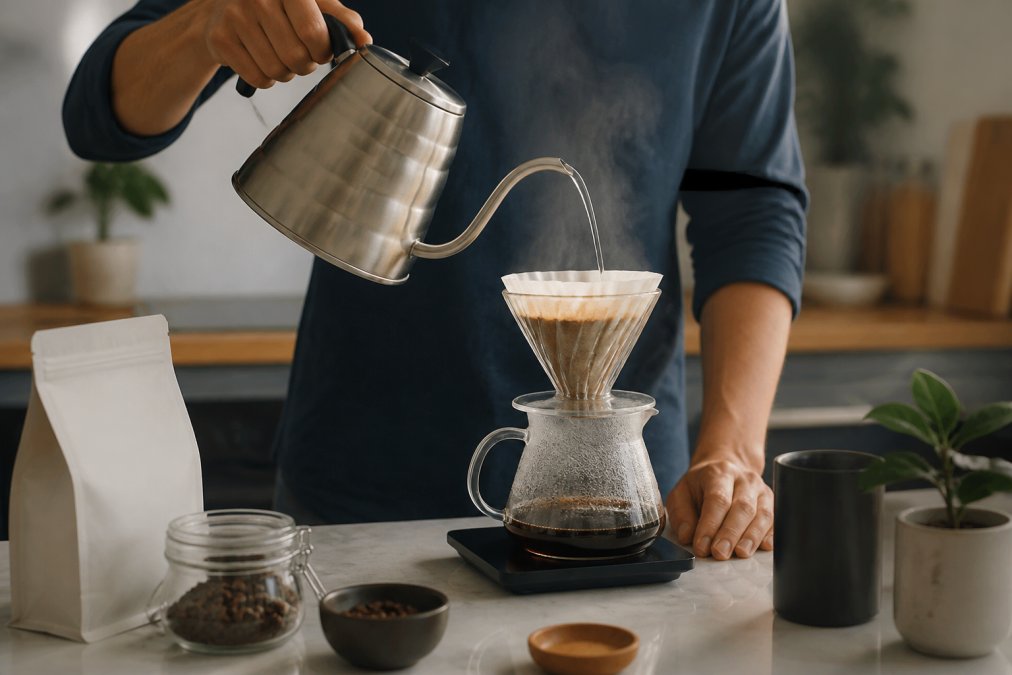
Step 1: Heat Your Water and Prep Your Gear
Heat water to between 195°F and 205°F. Rinse your filter paper with hot water to remove paper taste, then discard the rinse water. Weigh 20g of coffee and place your brewer on the scale.
Step 2: Weigh, Grind, and Bloom
Grind to medium. Add grounds to the filter, tare the scale, then pour 40-60g of water over the grounds. Wait 30-45 seconds. This is the bloom phase, where trapped carbon dioxide escapes. Skipping it causes uneven extraction.
Step 3: Pour, Wait, and Taste
Pour in slow circles to 320g total water. Aim for a total brew time of 2:30 to 3:30. Let it draw down fully, then taste. Adjust grind finer if sour, coarser if bitter.
Troubleshooting Common Brew Issues: Sour, Bitter, or Weak Coffee
Sourness and bitterness point to opposite problems, and fixing them is usually a matter of one adjustment at a time.
- Sour, thin, or sharp → under-extraction. Grind finer, raise water temperature, or extend brew time.
- Bitter, dry, or harsh → over-extraction. Grind coarser or shorten brew time.
- Weak but not sour → too much water. Tighten the ratio toward 1:15.
- Uneven, hollow taste → channeling. Improve pour technique and check grind consistency.
Beyond the Basics: Water Chemistry and Sensory Training for Beginners
Most beginner guides stop at grind and ratio. Two topics separate a competent home brewer from someone who actually tastes what they paid for: the water you brew with, and your ability to describe what's in the cup. Neither requires expensive gear, and both compound over time.
Water Chemistry Without the Chemistry Degree
Water makes up roughly 98% of your brewed coffee, so its mineral content directly shapes extraction. Two minerals matter most:
- Magnesium binds to coffee compounds readily and pulls out fruity, bright flavors. Too little and the cup tastes flat.
- Calcium carbonate (hardness) adds body and sweetness in moderate amounts, but in excess it mutes acidity and leaves a chalky finish.
- Alkalinity (bicarbonate buffer) is the sleeper variable. High alkalinity neutralizes coffee's natural acids, so a bright Ethiopian tastes dull. This is why very hard municipal water flattens flavor even when it's perfectly safe to drink.
- Filter your tap water with a simple carbon filter pitcher or faucet mount. This removes chlorine and some sediment, which is the most common cause of a chemical or band-aid note in the cup.
- Try bottled or remineralized water for one brew and compare it side by side with your tap. If the difference is obvious, your tap water is the bottleneck.
- Avoid distilled or reverse-osmosis water straight from the tap. It has almost no minerals, and coffee brewed with it tastes hollow and lifeless. If you use RO water, add a remineralization packet or a pinch of a brewing mineral blend.
Sensory Training: Building a Vocabulary for What You Taste
Sensory training isn't about having a gifted palate. It's about building a shared vocabulary so you can describe what you taste and then adjust your brew with intent. Three attributes do most of the work:
- Acidity is the bright, juicy sensation, think lemon, green apple, or cranberry. It is not the same as sourness. Sourness is a defect from under-extraction; acidity is a feature of well-brewed light roasts.
- Body is the tactile weight on your tongue, skim milk versus whole milk versus cream. French press tends toward heavier body; pour-over tends toward lighter.
- Sweetness is the caramel, brown sugar, or fruit note that shows up when extraction is balanced. If sweetness is missing, you're usually under- or over-extracting.
Sourcing: Reading the Bag Like a Beginner
Once your water and palate are sorted, sourcing is the next lever. Look for three things on a bag: the origin (country and, ideally, region or farm), the process (washed, natural, honey, anaerobic), and the roast date rather than a best-by date. A roast date within the last two to four weeks is a reasonable freshness target for most brewing methods.
Frequently Asked Questions
What equipment do I need to start brewing specialty coffee at home?
A burr grinder, a digital scale, a gooseneck kettle, and a brewing device like a pour-over dripper or French press are the essentials. A digital timer helps track brew time. You do not need to spend a fortune: a hand burr grinder and a basic scale cost under $60 combined. Fresh whole beans from a specialty roaster matter more than expensive gear. Start with a sample pack to find what you like before committing to a full bag.
What is the ideal coffee to water ratio for beginners?
Start with a 1:16 ratio, meaning 1 gram of coffee to 16 grams of water. For a standard 12-ounce cup, that is roughly 22 grams of coffee and 350 grams of water. This ratio produces a balanced cup that is neither too weak nor too strong. Adjust from there: use more coffee for a bolder taste or less for a lighter cup. A digital scale makes this consistent every time.
How does grind size affect the taste of specialty coffee?
Grind size controls how fast water extracts flavor from coffee. Too coarse and the water passes through quickly, leaving you with sour, weak coffee. Too fine and the water over-extracts, creating bitterness. Each brewer needs a different grind: coarse for French press, medium for drip, and medium-fine for pour-over. A burr grinder gives you consistent particle size, which is the single biggest upgrade you can make for better coffee at home.
What is the 15-15-15 rule for coffee?
The 15-15-15 rule is a simple starting point: 15 grams of coffee, 15 grams of water for the bloom, and 15 seconds of bloom time before your main pour. It is not a complete recipe but a way to remember the bloom phase. After the bloom, you add the rest of your water to reach your target ratio. This rule helps beginners build a repeatable routine without overthinking the process.
Learning to brew specialty coffee at home takes a scale, a burr grinder, and a willingness to adjust one variable at a time. Pure Brew Coffee is built for that ritual: meticulously sourced single-origin beans, transparent origin details, and an exclusive launch list you can join now to be the first to know when we open. Get started with Pure Brew Coffee and taste what careful sourcing does in your own kitchen.