

Table of Contents
- Why Grind Size Controls Flavor Extraction
- Coffee Grind Size Chart: Settings for Every Brewing Method
- Signs of Under-Extracted Coffee (and Over-Extracted Coffee)
- How to Dial In Espresso: A Step-by-Step Workflow
- Adjusting Grind Size for Pour-Over, French Press, and Drip
- Common Mistakes That Ruin Your Grind Adjustment
- Frequently Asked Questions
Last Updated: September 30, 2026
Why Grind Size Controls Flavor Extraction
Grind size is the single biggest lever you control over how your coffee tastes. It decides how fast water pulls flavor from the grounds, and small changes swing the cup from sour to bitter fast. This guide from Pure Brew Coffee breaks down how to adjust grind size for better flavor extraction, method by method.
Water can only dissolve what it touches. A finer grind creates more surface area, so water reaches more coffee at once; a coarser grind does the opposite. Get the grind wrong and no equipment will save the cup.
Surface Area, Contact Time, and Extraction Rate
Extraction rate is the speed at which water dissolves soluble material from coffee grounds. Finer particles expose more surface area, so extraction speeds up. Coarser particles slow it down.
Every method balances grind against contact time. Espresso uses a fine grind and 25-30 seconds of contact; French press uses a coarse grind and about four minutes of immersion. Both land in the same flavor zone only when the grind matches the method.
Coffee Grind Size Chart: Settings for Every Brewing Method
Use this chart as your starting point. Every grinder numbers its settings differently, so treat these as relative positions, not absolute numbers.
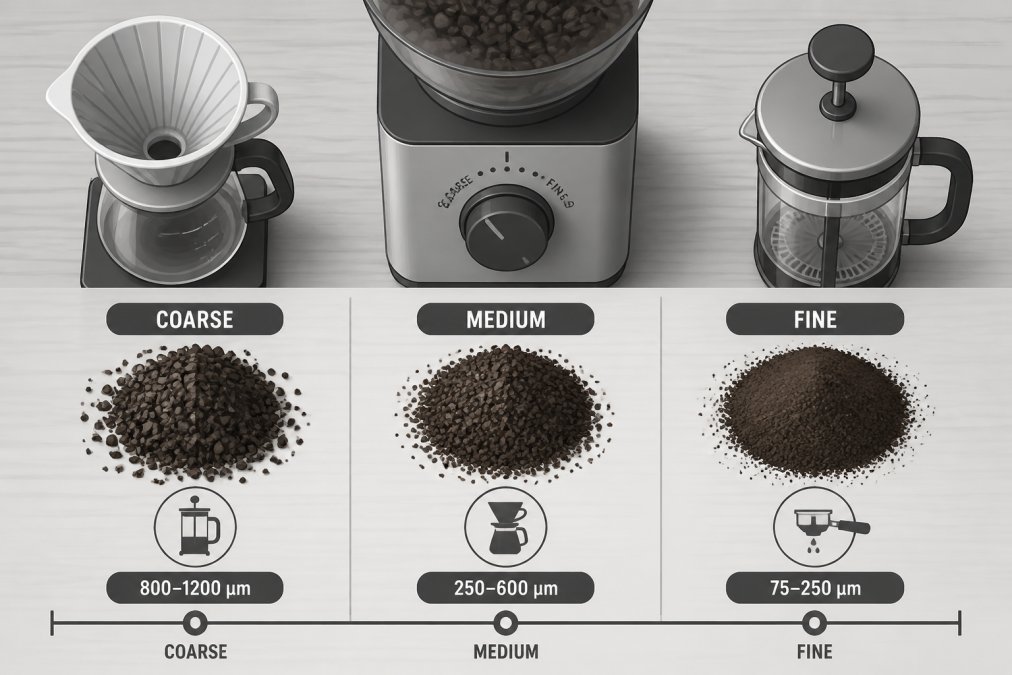
| Method | Grind Texture | Rough Setting | Contact Time |
|---|---|---|---|
| Espresso | Fine, like powdered sugar | 1-3 | 25-30 seconds |
| Moka pot | Fine-medium | 3-5 | 4-5 minutes |
| Pour-over | Medium, like table salt | 5-7 | 2.5-4 minutes |
| Drip machine | Medium | 6-8 | 4-6 minutes |
| French press | Coarse, like sea salt | 8-10 | 4 minutes |
| Cold brew | Very coarse | 10+ | 12-18 hours |
A burr grinder gives you repeatable settings. Blade grinders chop unevenly, producing fines and boulders that extract at different rates and muddy the flavor.
The Texture Guide: Match Your Grind to Something in Your Kitchen
If you do not own a burr grinder, or use a hand grinder with no numbered settings, the dial number is meaningless. Pinch dry grounds and compare the feel to a common kitchen ingredient.
- Powdered sugar (espresso). Rub it between your fingers and it disappears into the ridges. Almost no grit; press it and it clumps slightly.
- Table salt (pour-over, drip). Small, uniform grains you can feel individually, the texture most people picture for "medium grind."
- Coarse sand (French press). Clearly separate grains you can pick out individually, like sand at the bottom of a beach bag.
- Sea salt (cold brew). Larger, irregular chunks that crumble instead of packing when squeezed.
Do this check with dry grounds, not wet, wet grounds clump and lie to your fingers.
Why Your Grinder's Numbers Do Not Match This Chart
Two grinders set to "6" can produce completely different particle sizes. The chart assumes a well-maintained burr grinder; three things break that assumption.
A Note on Roast Level and Bean Density
The chart assumes a medium roast, but roast level and bean density shift the starting point. Darker roasts are less dense and dissolve more easily, so they often need a slightly coarser grind. Lighter roasts are denser and usually need a finer setting to extract fully, and high-altitude beans are denser too. Use the chart as a baseline, then adjust one notch in the direction the bean tells you.
Signs of Under-Extracted Coffee (and Over-Extracted Coffee)
Under-extracted coffee tastes sour, sharp, and thin; over-extracted coffee tastes bitter, dry, and hollow. Both come from the same place: the grind does not match the brew time.
The Visual and Tactile Check: Fines, Boulders, and Particle Size Distribution
Rub a pinch of dry grounds between your fingers: fine grounds feel like flour, coarse grounds like coarse sand. This 10-second check tells you more than any setting number.
How to Dial In Espresso: A Step-by-Step Workflow
Dialing in means finding the grind that hits your target brew time and taste. The workflow below is written for espresso, but the same logic applies to every method, the numbers just change. Change only one thing at a time.
The Espresso Workflow
- Lock your dose. Pick a fixed weight of dry coffee and use it every shot. Most home setups land between 16 and 20 grams in a double basket.
- Set a target time. Aim for a shot that finishes in roughly 25-30 seconds.
- Pull a test shot. Watch the flow rate and note the total time.
- Taste it. Sour and fast means grind finer. Bitter and slow means grind coarser.
- Adjust in small steps. Move the grinder one notch at a time.
- Repeat until the time and taste line up. Expect three to five shots.
- Log your setting. Write down the grind number, dose, and time so you can return to it.
The espresso shot is unforgiving because contact time is so short. A change that would barely register in a French press can wreck a shot, which is why espresso rewards a good grinder more than any other method.
The Same Workflow for Pour-Over, Drip, and French Press
Most guides stop at espresso, but most home brewers use a dripper, batch machine, or press, methods that need their own dialing-in loop because the feedback signals differ. Here is how to run the same seven-step logic for each.
Why the Feedback Signal Changes by Method
The espresso workflow leans on shot time because contact time is measured in seconds. Pour-over leans on drawdown because the bed is visible and flow rate shows how fast water moves through the grounds. Drip leans on cycle time and bed shape because you cannot see the brew. French press leans on steep time because the grind is already coarse and water is in contact the whole time.
Adjusting Grind Size for Pour-Over, French Press, and Drip
Pour-over, French press, and drip each need a different grind because each extracts differently. Pour-over is percolation: water passes through the bed once. French press is immersion: grounds steep in water the whole time.
Common Mistakes That Ruin Your Grind Adjustment
Most bad cups trace back to a handful of repeatable errors. Fix these and your adjustments will stick.
- Changing the grind and the dose at once. You lose the ability to tell which change worked.
- Judging by the number, not the taste. Grinder settings are not universal. Your "6" is not someone else's "6."
- Ignoring burr alignment. A misaligned burr set produces an uneven grind no setting can fix.
- Skipping the water. Water chemistry changes how well coffee dissolves. Very hard water mutes flavor; very soft water can taste flat.
- Grinding too far ahead. Ground coffee loses aroma fast. Grind right before you brew.
- Never cleaning the burrs. Oils build up and stale grounds skew every subsequent adjustment.
Frequently Asked Questions
What should I set my grind size to for different brewing methods?
Start coarse for French press (about the texture of sea salt), medium for drip and pour-over (like table salt), and fine for espresso (like powdered sugar). Use a coffee grind size chart as your baseline, then adjust one notch at a time based on taste. If your coffee tastes sour, go finer. If it tastes bitter, go coarser. Always change only one variable at a time so you know what worked.
How do I know if my coffee is under-extracted or over-extracted?
Under-extracted coffee tastes sour, sharp, and thin, with a salty edge and almost no sweetness. Over-extracted coffee tastes bitter, dry, and hollow, sometimes with an ashy finish. Both problems come from the grind size not matching your brew time and water temperature. Signs of under-extracted coffee usually mean your grind is too coarse for the method, so the water passes through too fast to pull out the sugars.
Is a finer grind a higher or lower number on a grinder setting?
On most burr grinders, lower numbers mean finer and higher numbers mean coarser, but this varies by brand. Some grinders reverse the scale entirely. Ignore the numbers and judge by feel and taste instead. Rub the grounds between your fingers: finer feels like flour or powdered sugar, coarser feels like sand or sea salt. Once you find a setting that tastes right, note it so you can return to it.
How often should I adjust my grind size?
Adjust whenever the coffee tastes off, when you switch beans, or when you change brewing methods. Fresh beans need finer settings than beans that have rested for two weeks, because they release gas that slows water flow. Humidity and burr wear also shift your baseline over time. Check your grind at least once per bag of beans, and re-dial in espresso daily if you want consistent shots.
Great coffee starts with a grind that matches your method, and it finishes with beans worth the effort. Pure Brew Coffee is built for that second half: meticulously sourced, single-origin offerings for people who care what lands in the cup. Join the newsletter to get early access at launch, be first to know when we go live, and brew with beans selected to reward the dialing-in work you just learned.