

Table of Contents
- What Makes Specialty Coffee Beans Worth the Investment
- Single-Origin Coffees and Regional Flavor Profiles
- Roast Levels and Tasting Notes Explained
- Best Coffee Subscriptions 2026
- Fresh Roasted Coffee Beans Online: What to Look For
- How to Store Coffee Beans for Maximum Freshness
- Coffee Beans Freshness After Roasting: Timeline and Storage
- Sourcing, Quality Standards, and Ethical Practices
- Frequently Asked Questions
Last Updated: October 17, 2026
What Makes Specialty Coffee Beans Worth the Investment
Specialty coffee isn't a premium product, it's a different category.
At Pure Brew Coffee, enthusiasts invest in quality because they understand what they're getting: single-origin beans, freshly roasted to order, and sourced with transparency. Individual bags start at $24.99.
Three factors separate specialty from commodity coffee: origin traceability, roast profile precision, and freshness. Specialty coffees score 80 points or higher on the Specialty Coffee Association scale.
Single-Origin Coffees and Regional Flavor Profiles
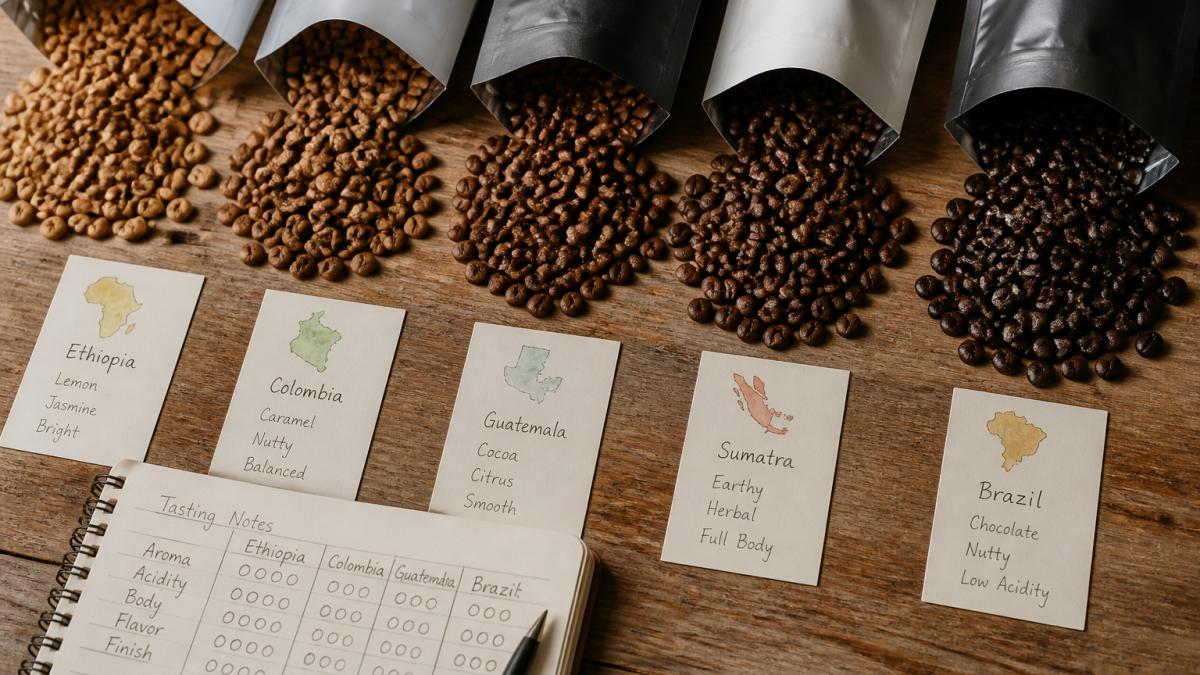
Single-origin coffees come from a specific region, farm, or cooperative, so terroir, altitude, soil, climate, and processing shape the flavor profile. When you buy specialty coffee beans online that are single-origin, you're getting a direct expression of place.
African Origins: Ethiopia and Kenya
Ethiopia is the birthplace of coffee, and its beans carry that heritage: bright acidity with fruity and floral notes like blueberry, jasmine, or bergamot. Our Ethiopia Natural comes from Sidama, where high altitude (1,700-1,900 meters) and natural processing yield milk chocolate, fruity, and caramel characteristics.

Kenya produces similar brightness with more citrus and stone fruit. Beans from the Othaya region deliver orange, lemon, and floral notes with an effervescent quality.
Central and South American Coffees
Central American coffees tend toward balanced, chocolatey profiles with subtle sweetness. Colombian coffees from Medellin offer dried orange, berry, and chocolate notes, versatile in espresso or drip. Costa Rican beans from Alajuela bring sweet apple, raisin, and honey, often eco-pulped to reduce water waste.
South American coffees from Peru and Brazil emphasize body and smoothness. Our Peru delivers salted caramel, silky sweetness, and citrus, while Brazilian Santos from Parana and São Paulo provides an elegant, smooth cup with cocoa notes.
Indonesian and Specialty Blends
Indonesian coffees stand apart due to wet-hulling. Our Bali Blue from Kintamani exemplifies this style: medium-dark roast with dark chocolate, molasses, and brown sugar notes, with volcanic soil and high altitude creating lower acidity and fuller body than African or Central American origins.

Specialty blends combine beans from multiple origins for a balanced, intentional profile. Our Whiskey Barrel Aged is experimental: a single-origin Guatemala aged 30 days in bourbon barrels, then roasted to order, creating layered complexity beyond traditional single-origins.
Roast Levels and Tasting Notes Explained
Roast level changes how you experience the coffee's origin. Light roasts preserve origin characteristics, so you taste terroir directly. Medium roasts balance origin flavors with roasting notes. Dark roasts emphasize body and forward chocolate, caramel, and spice notes, sometimes obscuring origin.
| Roast Level | Flavor Emphasis | Best Brewing Method | Coffee Body |
|---|---|---|---|
| Light (Med-light) | Bright acidity, origin flavors | Pour-over, Chemex, AeroPress | Light to medium |
| Medium | Balanced, chocolate, nuts | Drip, espresso, French press | Medium |
| Dark (Med-dark) | Chocolate, molasses, spice | Espresso, French press | Full |
Tasting notes describe what you might perceive in the cup; they are not added flavors but actual flavor compounds in the bean. Our Ethiopia Natural's milk chocolate and fruity notes come from the bean's chemical composition and how roasting develops those compounds.
Match Roast, Grind, and Flavor to Your Brewing Method
The same bean performs differently across brewers.
Espresso. Espresso rewards medium to medium-dark roasts with enough body to stand up to pressure.
Pour-over and Chemex. These highlight clarity and acidity, so light to medium-light roasts are the natural match.
French press. Full immersion and a metal mesh filter let oils and fines through for a heavier body.
Automatic drip brewer. The most common and forgiving home method.
AeroPress. Flexible enough for almost any roast.
Grind Freshness and Roast Date Interaction
Grind immediately before brewing. Pre-ground coffee loses aromatic compounds quickly, most noticeably in light roasts where delicate floral and fruit notes dominate.
Roast date and grind interact with rest time. Very fresh beans (days 1-3) release carbon dioxide that interferes with even extraction, especially in espresso. Buying whole bean and grinding to order gives you control over this window; pre-ground removes it.
Best Coffee Subscriptions 2026
A coffee subscription is only as good as the freshness and flexibility it delivers. Rather than ranking roasters by marketing copy, use consistent criteria to compare any subscription on equal terms.
1. Roast-to-order versus warehouse stock. Ask whether beans are roasted after you order or pulled from inventory.
**2.
3. Scheduling flexibility. The best subscriptions let you skip, pause, change frequency, or swap coffees without penalty.
4. Delivered cost, not sticker price. Compare price per ounce after shipping and discounts.
5. Customization. Can you choose origins, roast levels, whole bean versus ground, and decaf?
Single Origin Favorites Sample Pack →
How to Compare Delivered Cost
Sticker price hides the real cost. To compare subscriptions fairly, calculate price per ounce after shipping and discounts. A 12 oz bag at $24.99 with $6 shipping works out to about $2.58 per ounce delivered. A 16 oz bag at $28 with free shipping over $35 works out to about $1.75 per ounce if you combine it with a second bag. The larger bag is meaningfully cheaper per cup, even though the sticker price is higher.
Watch for these cost traps:
- Minimum orders and free-shipping thresholds. Many roasters waive shipping above a set order value. If you drink one bag every three weeks, you may never hit the threshold, so factor shipping into every order.
- Subscription discounts. Recurring plans often discount 5-15% versus one-time purchases. Confirm whether the discount applies to every shipment or only the first.
- Bag size. A 12 oz bag and a 16 oz bag are not directly comparable. Normalize to price per ounce before deciding.
- Shipping speed versus freshness. Faster shipping costs more but delivers beans closer to peak. For espresso, where a 5-7 day rest after roast is often preferred, a slightly slower ship can actually land your beans in the ideal window.
Subscription Models to Know
- Curated roaster's choice. The roaster selects coffees each cycle. Best for exploration and for drinkers who want variety without deciding.
- Build-your-own. You pick origins and roast levels. Best for drinkers with a fixed brewing routine who want consistency.
- Single-origin rotation. A new origin each cycle. Good for palate training, less good if you find a coffee you love and want to reorder.
- Sample or flight boxes. Smaller bags across several origins. The most efficient way to explore before committing to full-size bags.
Pure Brew Coffee operates on a pre-launch model, inviting early subscribers to join our newsletter for exclusive access when we officially launch. Individual bags start at $24.99, and our Single Origin Favorites Sample Pack at $24.99 is an entry point to explore multiple origins before committing to full-size bags.

Fresh Roasted Coffee Beans Online: What to Look For
Freshness is the single most important factor when you buy specialty coffee beans online. Check for a roast date on the packaging, this tells you exactly when the beans were roasted.
Whole beans stay fresher longer than pre-ground coffee because grinding dramatically increases surface area, accelerating oxidation and flavor loss. If you're buying online, always choose whole beans unless you lack a grinder.
Look for roasters who describe their sourcing transparently: specific farm names, altitude, processing methods, and varietal information. Our Colombia offering, for example, specifies smallholder farmers in Medellin, grown at 1,300-1,500 meters, using fully washed and solar-dried processing.
How to Store Coffee Beans for Maximum Freshness
Coffee degrades through four primary mechanisms: oxidation, moisture absorption, heat exposure, and light exposure. Proper storage addresses all four.
Store whole beans in an airtight container away from direct sunlight, heat sources, and moisture. A dark cupboard or pantry works better than a countertop. Avoid refrigerators and freezers, the temperature fluctuations and humidity create condensation that damages beans.
Once you open a bag of specialty coffee beans, consume the beans within 2-3 weeks for optimal flavor.
Grind immediately before brewing, never in advance.
Coffee Beans Freshness After Roasting: Timeline and Storage
The freshness timeline for specialty coffee follows a predictable arc. Immediately after roasting (days 1-3), beans are still releasing CO2, so the coffee may not extract optimally in some brewing methods, particularly espresso.
Optimal drinking window spans days 7-21 after roasting.
After day 21, the coffee remains drinkable but begins losing complexity.
Proper storage extends the optimal window slightly.
Sourcing, Quality Standards, and Ethical Practices
Specialty coffee operates on transparency and direct relationships. The Specialty Coffee Association evaluates coffee on 16 attributes, from fragrance and flavor to acidity and balance. Beans scoring 80+ points qualify as specialty grade.
Direct trade relationships mean roasters work directly with farms or cooperatives, paying premium prices that benefit growers. This model eliminates middlemen and ensures farmers receive fair compensation.
Look for roasters who document their sourcing relationships.
Processing methods also matter ethically and flavor-wise.
| Origin | Processing | Flavor Profile | Ethical Focus |
|---|---|---|---|
| Ethiopia (Sidama) | Full natural, hand-sorted | Milk chocolate, fruity, caramel | Smallholder farmers, heirloom varieties |
| Colombia (Medellin) | Fully washed, solar-dried | Dried orange, berry, chocolate | Smallholder farmers, cooperative model |
| Costa Rica (Alajuela) | Eco-pulped, sun-dried | Sweet apple, raisin, honey | Water conservation, micro-farm scale |
| Bali (Kintamani) | Wet-hulled, raised beds | Dark chocolate, molasses, brown sugar | Smallholder farmers, volcanic terroir |
When you buy specialty coffee beans online, you're supporting agricultural communities and sustainable farming practices.
Buying specialty coffee beans online connects you directly to the origin story behind each cup. Start with our Single Origin Favorites Sample Pack to explore multiple origins, then subscribe to your preferred selections when we officially launch.
Frequently Asked Questions
What's the difference between specialty coffee beans and regular coffee?
Specialty coffee beans are graded and scored for quality, with documented origins, specific roast profiles, and distinctive tasting notes. Regular coffee often blends beans from multiple origins without traceability. Specialty coffees emphasize single-origin selections, cupping scores, and intentional roasting to highlight regional characteristics like floral notes, fruit, or chocolate undertones. The sourcing also matters, specialty roasters often work directly with growers, ensuring ethical practices and consistent quality.
How long do specialty coffee beans stay fresh after roasting?
Whole specialty coffee beans peak in flavor 5-7 days after roasting and remain fresh when stored properly in an airtight container away from heat and light. The roast date on the bag is your best indicator, look for beans roasted within the past 2 weeks. After 4 weeks, beans begin losing aromatic compounds and flavor complexity. Ground coffee deteriorates faster. Once opened, use beans within 10-14 days for optimal taste.
Should I buy whole-bean or pre-ground specialty coffee?
Whole-bean specialty coffee is superior if you have a grinder. Grinding releases aromatic oils and volatile compounds, so beans ground just before brewing preserve maximum flavor. Since specialty coffee represents an investment in quality and traceability, whole beans allow you to experience the intended tasting profile, fruity notes, chocolate undertones, and regional characteristics, that the roaster worked to develop.
How should I store specialty coffee beans to keep them fresh?
Store whole beans in an airtight container in a cool, dark, dry place, a pantry or cupboard away from the stove, sunlight, and temperature fluctuations. Avoid the refrigerator or freezer; condensation degrades flavor. Keep beans in their original bag if it's resealable, or transfer to a glass jar with an airtight seal. Buy smaller quantities more frequently rather than stockpiling.
What makes a coffee subscription worth the cost?
A specialty coffee subscription delivers freshly roasted beans on a schedule that matches your consumption, eliminating stale coffee and the need to remember reorders. You gain access to rotating single-origin selections and exclusive roasts unavailable for individual purchase. Subscriptions often provide tasting notes, brewing recommendations, and education about origins and roast profiles. At $24.99 per bag, a monthly subscription guarantees consistent quality. The real value lies in discovering new origins, supporting direct-trade relationships with growers, and enjoying peak-freshness beans throughout the month.