

Table of Contents
- What Makes Specialty Coffee Worth Brewing Right
- Essential Coffee Brewing Tools for Home
- Coffee Brewing Ratios for Beginners
- Best Coffee Grind Size for Pour Over and Other Methods
- Water Temperature and Extraction Science
- Step-by-Step Brewing Methods That Work
- Common Brewing Mistakes to Avoid
- Frequently Asked Questions
Last Updated: September 25, 2026
What Makes Specialty Coffee Worth Brewing Right
To brew specialty coffee demands precision and intention that mass-market coffee never requires. Most home brewers waste exceptional beans by approaching them like commodity coffee, which fundamentally changes the cup.
The difference comes down to extraction. Specialty coffee is roasted to highlight specific flavor notes that disappear if your water temperature is off by 10 degrees, your grind is inconsistent, or your brew time drifts.
What separates a mediocre cup from an exceptional one is rarely the coffee itself, it's the method. A single-origin Ethiopian Natural with milk chocolate and fruity notes becomes thin and sour if under-extracted, or bitter and flat if over-extracted. The window is narrow.

Essential Coffee Brewing Tools for Home
You don't need expensive equipment to brew specialty coffee well. The three non-negotiables are a burr grinder, a scale, and a kettle you can control.
Blade grinders produce inconsistent particle sizes that guarantee uneven extraction. A burr grinder (conical or flat) produces uniform grounds. Entry-level burr grinders start around $30-40; consistency matters more than brand prestige.
A scale eliminates brewing error. A gram of coffee isn't always a gram when measured by scoops, it depends on how tightly you pack, grind fineness, and bean type. A digital scale reading to 0.1 grams costs $15-25 and improves your brewing more than any other single tool.
A gooseneck kettle lets you pour slowly and precisely, controlling pour rate and water distribution. This matters most for pour-over but helps with any immersion method.
Beyond those three, everything else is optional. A simple dripper or French press costs $10-30. Specialty coffee doesn't require expensive equipment.
Coffee Brewing Ratios for Beginners
Most specialty coffee tastes best at a ratio between 1:15 and 1:18 (1 gram of coffee to 15-18 grams of water), producing balanced extraction without advanced technique.
Start at 1:16 and adjust from there. If it tastes thin or sour, try 1:15 next time. If it tastes bitter or flat, try 1:17.
| Ratio | Coffee (grams) | Water (grams) | Best For | Adjustment |
|---|---|---|---|---|
| 1:15 | 20 | 300 | Fuller body, richer flavor | If brew tastes thin or sour |
| 1:16 | 20 | 320 | Balanced, good starting point | Standard recommendation |
| 1:17 | 20 | 340 | Lighter body, brighter acidity | If brew tastes bitter or flat |
| 1:18 | 20 | 360 | Delicate, tea-like body | For light roasts or high-altitude beans |
Brew time and grind size interact with ratio. A finer grind extracts faster, a coarser grind extracts slower. If your 1:16 ratio tastes under-extracted at the recommended time, your grind is too coarse. If over-extracted, your grind is too fine.
Best Coffee Grind Size for Pour Over and Other Methods
Grind size is the single biggest variable in extraction and where most home brewers stumble.
Grind size controls how fast water moves through the coffee bed. A fine grind slows water down, increasing extraction. A coarse grind lets water flow quickly, decreasing extraction.
Pour-over requires a medium-fine grind to extract fully in 2.5-4 minutes. French press requires a coarse grind; water sits for 4 minutes, so coarser particles prevent over-extraction. AeroPress works with medium-fine to medium grind since you control extraction time.
Most grinder settings don't match standard descriptions. Grind a small amount and feel it between your fingers to determine if it's fine (table salt), medium-coarse (sea salt), or coarse (beach sand), then adjust accordingly.
Consistency matters as much as absolute size. Burr grinders outperform blade grinders because they produce more uniform particles.
Water Temperature and Extraction Science
Water temperature controls extraction speed. Most specialty coffee brews best between 195°F and 205°F (90-96°C).
Water below 195°F extracts incompletely, producing sour, thin coffee. Water above 205°F extracts too fast, producing harsh, flat coffee.
Temperature and grind size work together. Hot water with fine grind risks over-extraction; cool water with coarse grind risks under-extraction.
Most kettles reach 200-202°F when boiled. Using a thermometer for your first few brews teaches you your kettle's behavior so you can adjust grind or brew time accordingly.
Water quality matters. Hard water over-extracts; very soft water under-extracts. Filtered tap water usually works well. If your tap water tastes off, your coffee will too.
Step-by-Step Brewing Methods That Work
Each brewing method has a different extraction mechanism. Understanding it helps you troubleshoot when something goes wrong.
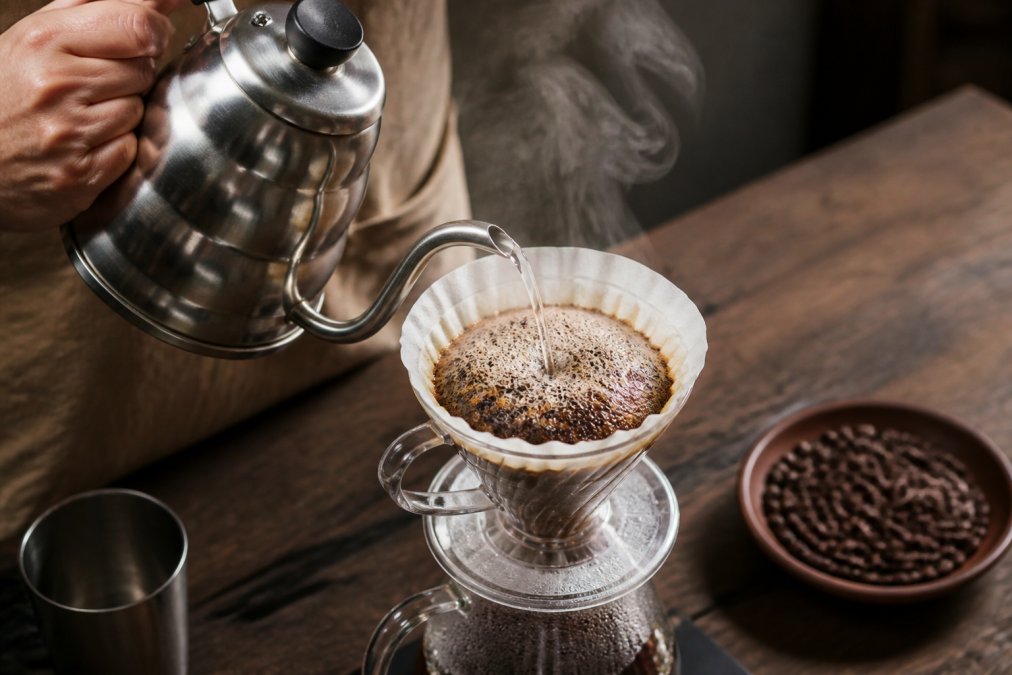
Pour-Over Brewing Method
Pour-over is a percolation method: water flows down through the grounds and out the bottom. You control the pour rate, which controls how long water stays in contact with the coffee. This makes pour-over forgiving for beginners, if extraction seems off, you can adjust your pour speed on the next brew.
Setup: Use a medium-fine grind, a 1:16 ratio, and water at 200°F. Rinse your filter with hot water, add grounds, and pour just enough water to wet them evenly (the "bloom"). Wait 30-45 seconds to allow CO2 to escape.
Brew: Pour remaining water slowly in circular motions over 2.5-4 minutes. If it drains faster, your grind is too coarse; if slower, too fine.
Result: Pour-over produces a clean cup with bright acidity; the paper filter removes oils so tasting notes shine through.
French Press Technique
French press is an immersion method: grounds sit in hot water for the entire brew time. Water doesn't flow through, it stays in contact with all the grounds equally. This produces a fuller body but requires more precision to avoid over-extraction.
Setup: Use a coarse grind, a 1:15 ratio, and water at 200°F. Add grounds, pour water to just below the rim, stir gently, and place the lid on top.
Brew: Let it sit for exactly 4 minutes, timing is critical. Press the plunger down slowly over 20-30 seconds.
Result: French press produces a full-bodied cup with more oils and texture than pour-over. The metal mesh filter allows oils through, which some prefer and others find heavy.
AeroPress Brewing Guide
AeroPress is a hybrid: it combines immersion (grounds sit in water) with pressure (you push air through). This gives you control over extraction time and intensity. AeroPress brews fast, usually 1-2 minutes total, which means you can use a finer grind without over-extracting.
Setup: Use a medium-fine grind, a 1:16 ratio, and water at 200°F. Place a paper filter in the basket and rinse it. Add grounds to the chamber, then pour water to just below the top. Stir for 10 seconds to ensure even saturation.
Brew: Place the AeroPress on top of your cup and wait 1 minute. Then push the plunger down slowly over 20-30 seconds. The entire process takes about 1.5 minutes.
Result: AeroPress produces a clean, balanced cup. It's forgiving because you control how fast you press, faster pressing extracts more, slower pressing extracts less. This lets you dial in extraction without changing grind size.
Drip Coffee Machine Basics
Automatic drip machines offer convenience but less control. Water heats in the machine's reservoir and drips through grounds into a carafe. You can't adjust pour rate or temperature mid-brew.
Setup: Use a medium-fine grind and a 1:16 ratio. Fill the reservoir with filtered water and add grounds to the filter basket. Most machines heat water to 195-205°F, which is acceptable. Some machines brew too hot or too cold, if your coffee consistently tastes off, your machine might be the culprit.
Brew: Start the machine and let it run. Most machines complete a full pot in 5-10 minutes depending on volume. The brew happens without your input.
Result: Drip machines produce a clean cup similar to pour-over. The advantage is consistency and convenience. The disadvantage is lack of control. If extraction seems off, you can only adjust grind or ratio next time, you can't adjust during the brew.
Moka Pot Instructions
A Moka pot brews with steam pressure, similar to a small espresso machine. It produces a strong, concentrated brew that's excellent for milk-based drinks or as a base for Americanos.
Setup: Fill the bottom chamber with water just below the safety valve.
Common Brewing Mistakes to Avoid
Most brewing problems trace back to three variables: grind size, water temperature, and brew time. Understanding what each controls helps you troubleshoot.
Frequently Asked Questions
What is the best coffee-to-water ratio for brewing specialty coffee?
The standard ratio for specialty coffee is 1:16 (one part coffee to 16 parts water by weight). For example, use 20 grams of coffee with 320 grams of water. This ratio produces balanced extraction with good body and clarity. Adjust slightly based on your grind size and brewing method, coarser grinds may need slightly more water, while finer grinds work better with less water to avoid over-extraction.
How does grind size affect specialty coffee extraction?
Grind size directly controls how fast water extracts flavors from coffee grounds. Finer grinds increase surface area, speeding extraction and creating fuller body but risking bitterness if over-extracted. Coarser grinds slow extraction, producing brighter acidity but risking under-extraction if brew time is too short. Match your grind to your brewing method: medium-coarse for French press, medium for drip, medium-fine for pour-over, and fine for espresso.
What water temperature should I use when brewing specialty coffee?
Water temperature between 195-205°F (90-96°C) extracts specialty coffee optimally. Temperatures below 195°F under-extract, leaving sour, thin flavors. Above 205°F, extraction happens too fast, creating bitter, harsh tastes. Let boiling water cool for 30 seconds before brewing. For light roasts, use the higher end of the range; for dark roasts, use the lower end to avoid over-extraction.
Why is agitation important in specialty coffee brewing?
Agitation, stirring or swirling the grounds, ensures even contact between water and coffee, preventing channeling (where water rushes through gaps) and under-extraction. In pour-over brewing, gentle agitation during the bloom phase helps release CO2 and improves flavor extraction. In immersion brewing like French press, agitation breaks up the crust of floating grounds, distributing flavors evenly throughout the brew.