

Table of Contents
- What Separates High-End Coffee Grinders From Mid-Range Models
- Flat Burr vs Conical Burr Grinder: Which Delivers Better Flavor
- Single Dose Coffee Grinder Benefits for Home Brewing
- Matching Your Grinder to Your Brewing Method
- Noise Profile, Footprint, and Build Quality
- Coffee Grinder Maintenance Tips for Long-Term Durability
- Best Coffee Beans for Home Espresso: What to Pair With Your Grinder
- Conclusion
- Frequently Asked Questions
Last Updated: September 20, 2026
What Separates High-End Coffee Grinders From Mid-Range Models
The best high-end coffee grinders for home use 2026 share one trait: they treat the burr set as the machine, not an accessory. Home brewers routinely spend four figures on an espresso machine, then grind with a blade chopper. That order is backwards.
A high-end grinder is built around a precision burr set, a motor sized to turn it without stalling, and an adjustment system fine enough to repeat yesterday's shot. Mid-range models compromise on all three.
Here is the practical difference:
- Burr size: High-end models typically run larger burrs, which grind faster and generate less heat.
- Adjustment: Micrometric or stepless settings let you move in tiny increments. Stepped budget grinders cannot.
- Consistency: Grind uniformity separates a balanced shot from a sour or bitter one.
The payoff is repeatability: a grinder that returns to the same setting every morning beats one with features you never touch.
Burr Size, Material, and Motor Torque
Larger burrs cut more coffee per rotation, so beans spend less time in the chamber and absorb less heat, and heat degrades aroma compounds before you ever pull a shot.
Steel burrs hold an edge far longer than ceramic, though ceramic resists heat and never rusts. For home use, steel is the better long-term bet.
Motor torque decides whether the grinder stalls on a light-roast bean. High-torque motors hold grind speed steady under load, keeping particle size predictable; a grinder that slows mid-dose changes extraction without warning.
Flat Burr vs Conical Burr Grinder: Which Delivers Better Flavor
Flat burr and conical burr grinders produce measurably different particle distributions, and that difference shows up in the cup. Neither is universally better. The choice depends on what you brew.
Flat burrs are two parallel discs. They produce a narrower particle spread with fewer fines, which reads as clarity and separation in the cup. Light-roast pour-over fans tend to prefer them.
Conical burrs are a cone inside a ring. They produce a slightly wider distribution and feed beans more gently, which suits espresso and darker roasts.
The trade-off: flat burrs demand more precise alignment, while conical burrs are more forgiving and often quieter.
Particle Distribution, Fines, and Boulders
Particle distribution is the range of sizes a grinder produces from a single dose. Every grinder makes some fines (dust-fine particles) and some boulders (oversized chunks). The question is how many.
Too many fines choke an espresso shot and slow a pour-over to a crawl; too many boulders leave the coffee under-extracted, tasting sour and thin.
Grind uniformity is what you are paying for at the high end. A well-aligned burr set narrows that spread, so more of your dose extracts at the same rate. That is why two grinders at the same setting can taste completely different.
Single Dose Coffee Grinder Benefits for Home Brewing
Single dose coffee grinder benefits come down to freshness and control: weigh the beans, grind exactly that amount, and leave nothing sitting in the chamber. For anyone brewing one or two cups a day, that is the whole argument.
Hopper-based grinders keep beans exposed to air, light, and heat. Single-dosing sidesteps that entirely.
The other benefit is switching beans. Trying a new origin means dumping the hopper and purging. With single-dosing, you just weigh the next dose.
Zero-Retention Design and Dosing Cups
Retention is the coffee left inside the grinder after you finish. On a high-retention machine, yesterday's grounds end up in today's cup. A zero-retention design pushes that leftover out, usually with a bellows or a steep internal path.
A dosing cup makes the workflow cleaner: grind into the cup, shake to break up clumps and reduce static, then pour straight into the portafilter or brewer.
Matching Your Grinder to Your Brewing Method
The right grinder depends entirely on how you brew. Espresso and filter coffee ask for different burr geometry, adjustment ranges, and workflows. One grinder can do both well, but it costs more and usually compromises at one end of the range.
A practical way to decide:
| Brewing Method | Burr Preference | Adjustment Need | Priority |
|---|---|---|---|
| Espresso | Conical or flat | Stepless, micrometric | Repeatability |
| Pour-over | Flat | Stepped is workable | Clarity, uniformity |
| Drip | Either | Basic range | Capacity, speed |
| Both espresso and filter | Flat | Wide stepless range | Versatility |
Most home brewers who drink both should prioritize a wide, stepless adjustment range over any single spec. A grinder that moves from a 9-bar espresso setting to a 1:16 pour-over setting without swapping burrs beats one that wins on a single metric.
Espresso Extraction and Dialing In
Dialing in means adjusting grind size until the shot tastes balanced. Small changes move extraction a lot, so espresso rewards micrometric adjustment. A grinder that jumps in big steps makes dialing in a guessing game.
A useful reference point: on a typical 18-gram double basket, a one-notch change on a stepped grinder can shift shot time by several seconds, while a stepless grinder lets you nudge flow in fractions of a second.
Pour-Over Clarity and Drip Versatility
Pour-over rewards grind uniformity more than raw precision. A flat burr set with tight particle distribution gives the clean, separated flavors light roasts are known for. Drip brewers are forgiving and work with almost any decent burr grinder.
Dual-Use Grinders and the Compromise
If you brew both espresso and filter, the honest trade-off is this: an espresso-optimized grinder tends to have a narrower usable range at the coarse end, and a filter-optimized grinder lacks the fine-resolution adjustment espresso needs. The way around it is a wide stepless range with burr geometry that stays consistent across the full sweep, usually a large-diameter flat burr set.
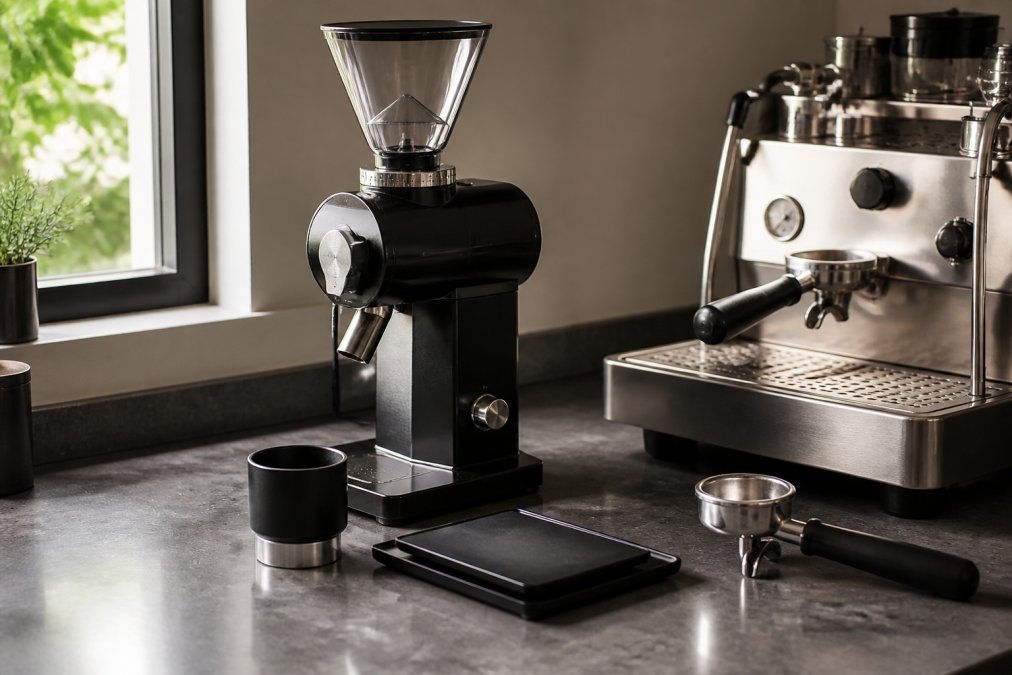
Noise Profile, Footprint, and Build Quality
Coffee Grinder Maintenance Tips for Long-Term Durability
Coffee grinder maintenance tips are simple, and skipping them is the fastest way to ruin a good burr set. Clean the burrs, check alignment, and replace worn parts on schedule. That is most of it.
- Brush out the burr chamber weekly to stop old grounds building up.
- Never wash burrs with water; use a dry brush or grinder cleaning tablets.
- Check burr alignment after any disassembly.
- Replace burrs once they dull, which shows up as slower grinding and more fines.
- Keep the motor vents clear so heat can escape.
Burr Alignment, Calibration, and Repairability
Burr alignment means the two burr surfaces sit parallel so the gap is even all the way around. Misalignment creates inconsistent particle sizes no matter how good the burrs are.
Best Coffee Beans for Home Espresso: What to Pair With Your Grinder
The best coffee beans for home espresso are fresh, recently roasted, and matched to your taste, not to a label. A great grinder exposes bean quality, good and bad. Stale beans taste flat no matter how precise your grind.
Conclusion
Choosing among the best high-end coffee grinders for home use 2026 comes down to matching burr type, adjustment range, and build quality to how you actually brew. Get that right and your grinder outlasts two espresso machines.
Frequently Asked Questions
Is it worth spending over $500 on a high-end coffee grinder?
A grinder above $500 typically delivers tighter particle distribution, lower retention, and more consistent results than budget models. For espresso, where small changes in grind size affect extraction, that consistency matters more than the machine itself. If you brew daily and care about flavor clarity, the investment pays off over years of use. If you mostly drink drip coffee, a mid-range grinder may be sufficient.
What are the benefits of flat burrs vs conical burrs in high-end grinders?
Flat burr grinders produce a more uniform particle distribution with fewer fines, which suits pour-over clarity and light roasts. Conical burr grinders generate a wider spread of particles, which can work well for espresso and darker roasts. Conical burrs often run quieter and cost less to replace. Your choice depends on the brewing method you use most and the flavor profile you prefer in the cup.
Do high-end coffee grinders require professional maintenance?
Most high-end grinders need only routine cleaning and occasional burr replacement. Brush out retained grounds weekly, and use grinder cleaning tablets monthly if you brew daily. Burrs typically last 500 to 1,500 pounds of coffee depending on material and roast level. Professional service is rarely needed unless you notice burr misalignment or motor issues. Check manufacturer guidance for your specific model.
What features should I look for in a premium 2026 coffee grinder?
Prioritize burr type and size, stepless or micrometric adjustment, low retention, and build quality. A grinder with stepless adjustment gives you finer control for dialing in espresso. Single-dosing capability reduces waste and keeps beans fresh. Also check noise profile, countertop footprint, and whether replacement burrs are readily available. These factors affect daily workflow more than extra features you may never use.