

Table of Contents
- Why Fake Gourmet Claims Matter
- How to Read a Coffee Label and Spot Red Flags
- Verifying Origin, Farm, and Traceability Claims
- Coffee Roast Date vs. Best-by Date: What's Actually Fresh
- Organic Coffee Certification Labels: What They Really Prove
- Difference Between Single-Origin and Blend Coffee Labels
- How to Decode Tasting Notes and Premium Language
- Your Five-Sign Checklist for Authentic Gourmet Coffee
- Frequently Asked Questions
Last Updated: October 15, 2026
Why Fake Gourmet Claims Matter
The coffee aisle is a minefield of fake gourmet coffee labels with misleading claims. Brands slap words like "gourmet," "artisanal," and "single-origin" on bags without substance behind them.
Specialty coffee isn't cheap, and fake gourmet claims exploit shoppers who see fancy words and assume quality.
A few key indicators separate authentic specialty coffee from marketing smoke.
How to Read a Coffee Label and Spot Red Flags
A real coffee label tells a story: where the beans came from, when they were roasted, and how they were processed.
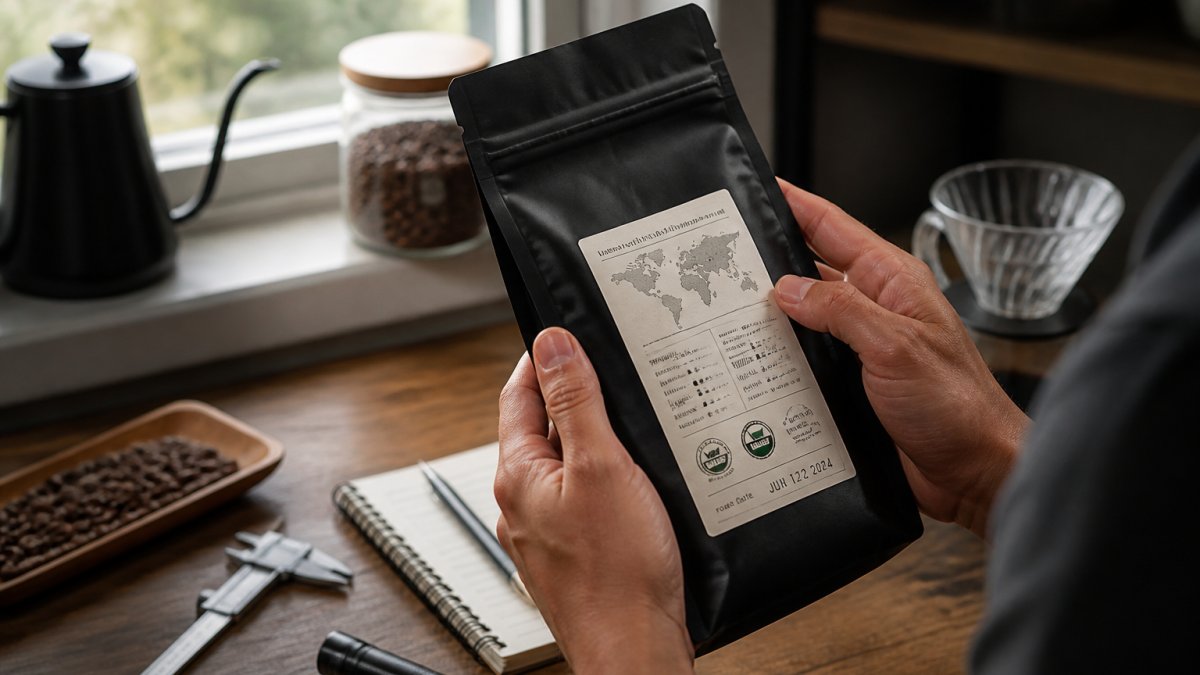
Start with the basics. Look for these elements on the front and back:
- Origin information, Where are the beans actually from?
- Roast date, When were they roasted?
- Processing method, How were they prepared?
If a label skips most of these, that's your first red flag.
Vague language is a warning sign. Phrases like "mountain grown" or "premium blend" mean almost nothing. Every coffee grows on a mountain somewhere. Premium is subjective.
Check the back label too. Legitimate roasters explain their sourcing, direct trade relationships, fair trade certification, or specific farm partnerships, plus altitude, harvest date, and tasting notes.
Verifying Origin, Farm, and Traceability Claims
This is where many fake gourmet coffee labels fall apart. A label might claim "Ethiopian Yirgacheffe from the Gedeo Zone", but can you verify it?
Authentic specialty roasters make traceability easy. They provide:
- Farm name or cooperative name, A real place you could theoretically visit
- Lot number, A specific batch identifier
- Harvest date, The actual month or season
Real single-origin coffee comes from a traceable source: direct-trade roasters can often name the farmer, and fair-trade certified coffees carry batch numbers tied to specific cooperatives.
A simple test: visit the roaster's website. Do they list specific farms, regions, and harvest dates for each coffee?
Coffee Roast Date vs. Best-by Date: What's Actually Fresh
Freshness is the easiest claim for a fake gourmet label to fake, because most shoppers don't know which date to look for.
The two dates, side by side
Roast date is the day the beans came out of the roaster, the only date that tells you how old the coffee actually is. Most specialty roasters print it as a clear day-month-year stamp on the bottom or back of the bag.
Best-by date ("best before," "enjoy by," or "use by") is a shelf-life estimate set by the seller. It doesn't tell you when the coffee was roasted, a bag with a best-by date eight months out could have been roasted last week or last spring.
Here is the practical difference:
| Date on the bag | What it tells you | What it hides |
|---|---|---|
| Roast date | Exactly how old the coffee is | Nothing, this is the honest date |
| Best-by date only | The seller's shelf-life estimate | The actual roast date and true age |
| Both dates | Age and the seller's freshness window | Nothing |
| No date at all | Nothing | Everything |
Why the roast date is the one that matters
Coffee is a fresh agricultural product, not a shelf-stable one. Once roasted, beans lose aromatic compounds through oxidation and off-gassing. Most specialty roasters put the peak drinking window at roughly two to four weeks after the roast date for whole bean, narrowing after grinding.
A best-by date cannot tell you where a bag sits inside that window. A roast date can.
The red flags on a freshness label
Watch for these specific patterns:
- Best-by date with no roast date. The most common deceptive pattern. The bag looks dated, but the useful information is missing.
- A roast date printed as a code, not a date. Strings like "L2247" or "B-0912" are batch codes, not roast dates. If the roaster will not translate the code on the bag or on their website, treat the freshness claim as unverified.
- A roast date that is suspiciously old for the price. A bag sold at a premium single-origin price with a roast date six or eight weeks in the past is not a fresh gourmet product, regardless of what the front of the bag says.
How to verify a freshness claim
You don't need special tools, just the bag and, ideally, the roaster's website:
- Find the roast date first. If it is not printed, the freshness claim is unverifiable.
- Compare the roast date to today. Whole bean coffee is generally at its best within about two to four weeks of roasting. If the bag is older, adjust your expectations, and your willingness to pay a premium.
- Check the roaster's site for a "roasted on" or "shipped on" policy. Many specialty roasters state that they roast to order or ship within a set number of days of roasting, a published policy is easier to trust.
- Look at the bag itself. Oily, dark beans or a flat, cardboard-like smell suggest older or over-roasted coffee, a clue, not proof. The roast date remains the most reliable indicator.
Organic Coffee Certification Labels: What They Really Prove
A certification seal is a claim with a paper trail behind it; marketing language is a claim with nothing behind it. Telling the two apart separates a real gourmet label from a fake one.
What a certification actually certifies
Every legitimate certification rests on three things: a written standard, an independent auditor, and a chain-of-custody record tying a specific batch of green coffee to that audit. If any is missing, the seal is decoration.
Here is what the most common seals on a coffee bag actually verify, and what they do not:
- USDA Organic. Verifies the coffee was grown and handled per the USDA National Organic Program, which prohibits most synthetic pesticides and fertilizers and requires record-keeping from farm to roaster. It says nothing about flavor, freshness, roast level, or farmer pay.
- Fair Trade USA. Verifies the importer paid a published minimum price plus a social premium to a certified cooperative meeting certain labor and governance standards. It does not verify cup quality or a specific farm name.
- Rainforest Alliance. Verifies the farm met environmental, social, and farm-management criteria at the time of audit. Not a flavor or freshness guarantee.
Notice the pattern: each seal proves one specific thing about how the coffee was produced. None prove the coffee is good, fresh, or worth a premium on its own.
How to verify a seal in about two minutes
Fake gourmet labels rely on shoppers never checking. Verification isn't complicated:
- Read the exact certifier name, not just the logo. "Certified organic" without a certifier is a claim. "Certified organic by [named certifier]" is a claim you can check.
- Look for a certificate number or license ID. Real certifications issue one. If the bag has a seal but no number, treat it as unverified.
- Search the certifier's public directory. USDA Organic operations are listed in the USDA Organic Integrity Database. Fair Trade USA and Rainforest Alliance both publish searchable lists of certified products and partners. If the roaster is not in the directory, the seal is suspect.
- Check the roaster's own site. A legitimate certified roaster names the certifier and often links to the certificate; a fake one says "organic" in body copy and never names a certifier.
The marketing words that imitate certifications
These phrases appear on fake gourmet labels because they sound like certifications without triggering any legal requirements:
- "Naturally grown"
- "Pesticide-free"
- "Eco-friendly"
None have a defined standard or third-party audit behind them. Some may be true, but none are verifiable from the label alone, which is exactly why deceptive brands use them.
What certification does not prove
Most label-reading guides skip this part: a certification is a floor, not a ceiling.
- It does not prove quality. Certified organic coffee can be stale, over-roasted, or poorly sourced. Some of the best specialty coffees on the market are not certified organic at all.
- It does not prove freshness. A certified bag with no roast date can still be months old.
- It does not prove a specific origin. A certified blend can contain coffee from several countries.
USDA Organic Integrity Database, search a certifier or operation
Difference Between Single-Origin and Blend Coffee Labels
Single-origin coffee comes from one country, region, or farm; blends combine beans from multiple origins.
Single-origin labels should specify the exact source.
Deceptive labels use single-origin language without specificity. "African blend" isn't single-origin, even though it sounds exclusive.
Blend labels combine origins to create a specific flavor profile, say, Ethiopian and Colombian beans to balance acidity and body.
Check the fine print.
Single-origin coffee typically costs more per pound because you're paying for specificity and traceability.
How to Decode Tasting Notes and Premium Language
Coffee labels love flowery language: "notes of blueberry and chocolate," "bright acidity with a silky finish." What do they actually mean?
Tasting notes describe flavors you might detect when you brew.
Premium language is another red flag. "Gourmet," "artisanal," and "premium" have no legal definition, any roaster can use them.
A quick test: do the tasting notes match the origin?
Your Five-Sign Checklist for Authentic Gourmet Coffee
Use this checklist when you're evaluating a coffee bag.
Sign 2: No roast date. Non-negotiable.
Sign 4: Generic tasting notes or premium language. "Smooth," "balanced," "gourmet," and "artisanal" mean nothing.
Sign 5: Price doesn't match the claim. Authentic single-origin coffee costs more than blends.
When you shop for coffee, look for transparency and specificity.
At Pure Brew Coffee, we're building our reputation on transparency.
Frequently Asked Questions
How can you verify a coffee's country or region of origin?
Authentic specialty coffee labels specify a precise origin: country, region, farm name, and often altitude. Verify this by checking the roaster's website for sourcing details, looking for lot numbers that trace to specific harvests, and confirming the farm exists through specialty coffee databases. Vague labels saying only 'South American blend' or 'premium imported' without specifics are red flags. Direct-trade roasters often publish producer relationships and harvest photos. If the roaster can't provide verifiable sourcing information, the origin claim is likely fabricated.
What does single-origin coffee mean on a label, and is it more trustworthy than a blend?
Single-origin coffee comes from one country, region, or farm; blends combine beans from multiple origins. Single-origin labels are not automatically more trustworthy, both can be authentic or fake. What matters is specificity: 'Ethiopian Yirgacheffe, Gedeo Zone' is verifiable; 'single-origin blend' is contradictory and deceptive. Blends can be excellent when the roaster clearly lists each origin and its percentage. Check if the roaster explains why they blended those specific coffees. Transparency about sourcing, whether single-origin or blend, signals authenticity more than the label category itself.
Does the word 'gourmet' on a coffee label guarantee quality?
No. 'Gourmet' is an unregulated marketing term with no legal definition or certification requirement. Any roaster can print it on a bag. Genuine quality indicators are specific: single-origin with farm name, altitude, and harvest date; third-party certifications like Specialty Coffee Association ratings; roaster transparency about sourcing and roasting dates; and verifiable producer relationships. Premium-sounding language alone, 'gourmet,' 'artisanal,' 'premium', without concrete sourcing details, roast dates, or certifications is a common deception tactic.
How can you tell whether coffee is freshly roasted by checking the label?
Look for a roast date, not a best-by date. Specialty coffee roasters print the roast date because fresher beans taste better. Coffee peaks 5-14 days after roasting and remains good for 4-6 weeks if sealed. If a label only shows 'best before' without a roast date, or if the best-by date is more than 6 months away, the beans are likely older or the roaster is hiding the roast date. Calculate backward: if best-by is January 15 and the bag arrived in December, the roast date was probably months earlier. Authentic specialty roasters always print roast dates because freshness is central to their value proposition.